Tuchel’s England: What to Expect at the World Cup

By Emanuele Mongiardo

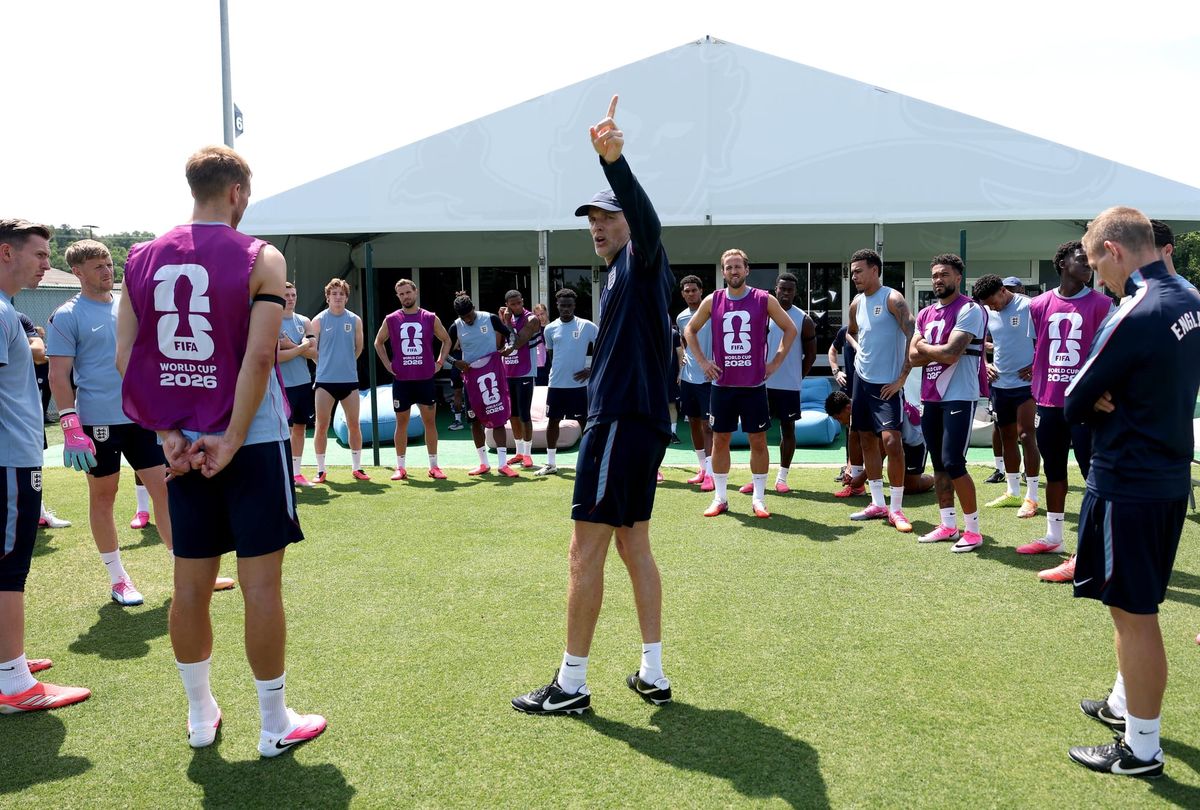
«I think from day one, we were very clear that we are trying to select and build the best possible team, which is not necessarily to select and collect the 26 most talented players. Teams win championships. It’s as simple as that. And what we are trying to achieve in the summer can only be achieved as a team.»
Thomas Tuchel
With these words, Thomas Tuchel attempted to quell the discontent of a large portion of English public opinion regarding his squad selection for the upcoming World Cup.
Controversies surrounding national team managers’ selections have always been part of the build-up to international tournaments. Sooner or later, every major national team has to deal with high-profile omissions or unexpected call-ups: it is the price to pay when you can draw from a pool of players as deep and talented as England’s.
The most significant absences from Tuchel’s squad are undoubtedly Phil Foden, Cole Palmer, and Trent Alexander-Arnold. While the latter has never fully enjoyed the trust of the German coach—who can also rely in that position on one of his loyal lieutenants from his Chelsea days, Reece James—it is more difficult to explain the exclusions of Foden and Palmer. Both endured difficult seasons, but is that enough to justify leaving out two attacking midfielders capable of changing a game at any moment?
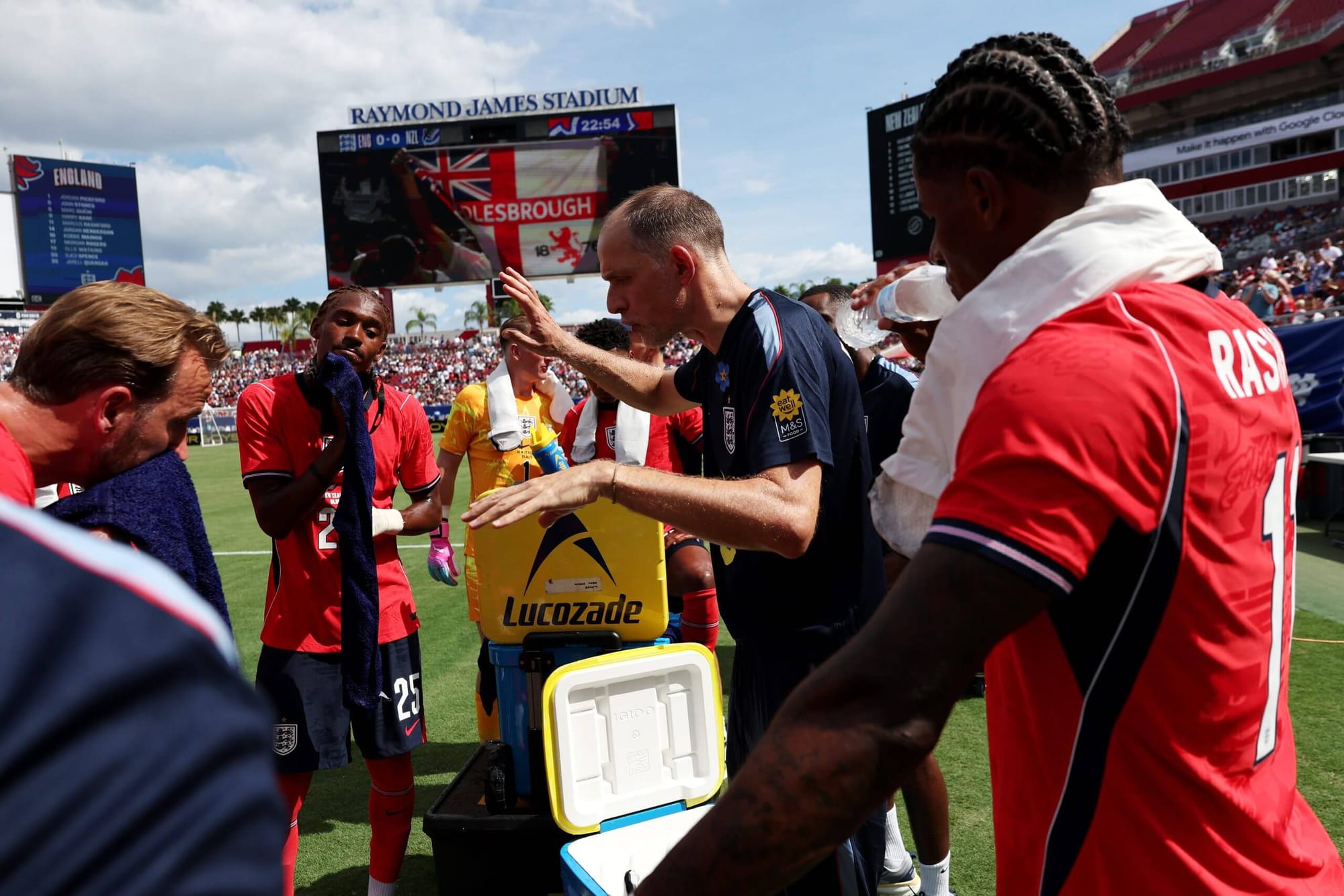
One is led to think that Tuchel, by preferring players who are more functional to his system, chose to leave them out in order to remove any ambiguity surrounding his game plan: not so much to avoid the temptation of changing his mind during the tournament, but rather to keep the public narrative under control. England is the European national team with the most obsessive relationship between the squad and its environment. The passion for the national team, combined with a trophy drought that has lasted since 1966, makes every European Championship and every World Cup a media challenge for England managers before it even becomes a footballing one.
In such a context, leaving certain players out means extinguishing from the outset any debate regarding the starting eleven and match plan. Thus, alongside the high-profile exclusions of Foden, Alexander-Arnold, and Cole Palmer, the omissions of emerging talents such as Adam Wharton—a genuine deep-lying playmaker, something rare in English football—and Morgan Gibbs-White, a wonderful all-action number ten who is nevertheless difficult for Tuchel to categorise, become easier to understand.
In short, the manager’s decisions may appear counterintuitive, but they possess an internal coherence.
With these premises established, where exactly does England stand? How does one of the favourites for the upcoming World Cup play?
What Kind of England Does Tuchel Want to Build?
When Tuchel inherited the job from Gareth Southgate, the Three Lions were primarily a defensive national team. The German coach was therefore able to start from a solid foundation. After all, he himself is obsessed with the defensive phase: his Champions League-winning Chelsea side was an extremely solid team, outstanding both in its spatial coverage and in its pressing.
Tuchel therefore also sought to build his foundations upon the defensive phase. Unlike Southgate, however, from the very beginning he has attempted to create a more aggressive England side, one that wants to attack the opponent both when pressing high and when defending in a medium block.
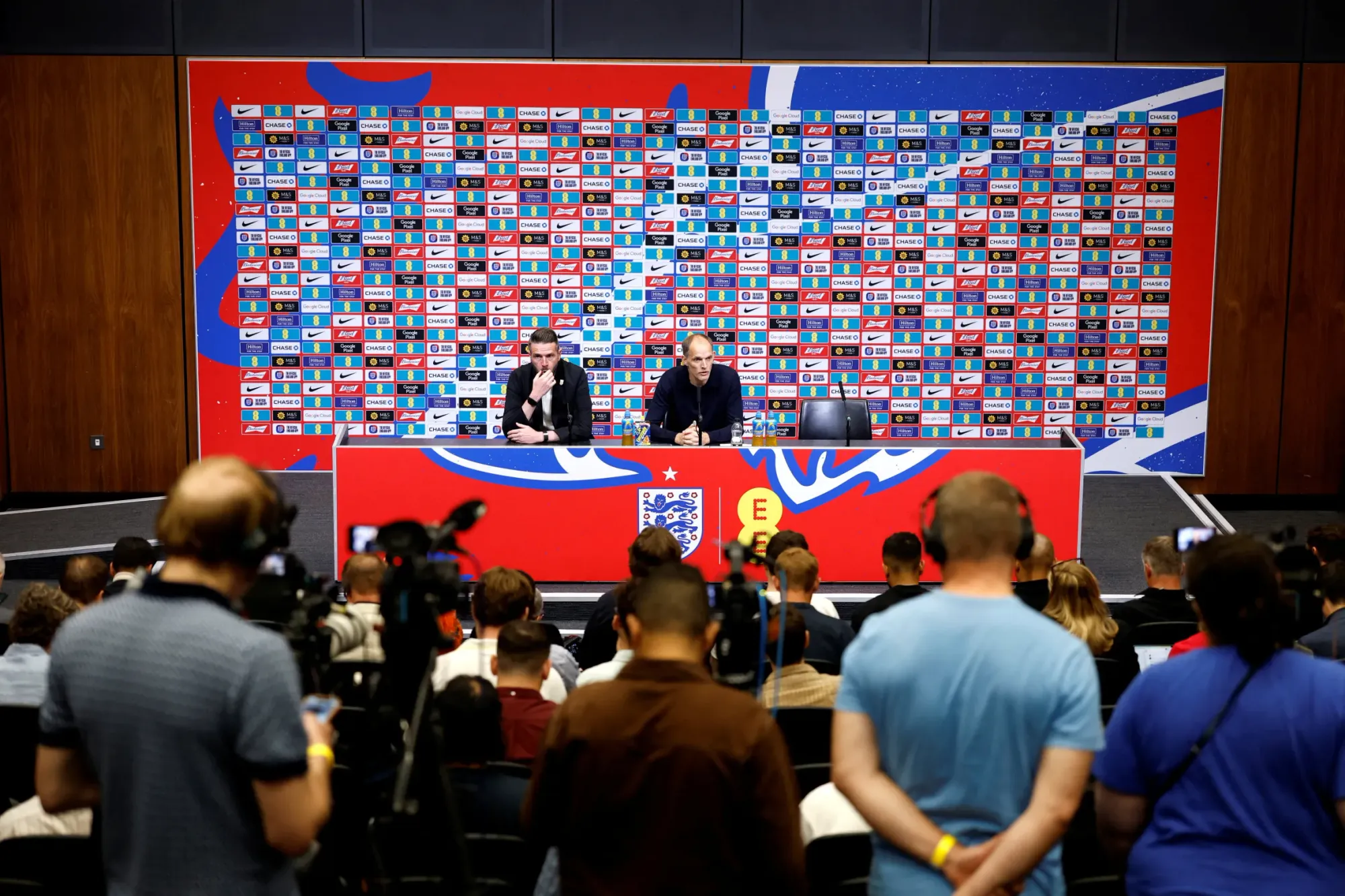
The other major difference compared to Southgate concerns possession. England between 2018 and 2024 were slow on the ball; their only real variations came through Harry Kane dropping deep and Raheem Sterling’s dribbling. Otherwise, Southgate’s idea was to make as few things happen as possible and then attempt to decide games through moments or incidents, even if that meant dragging matches all the way to penalties. Tuchel’s vision, from the outset, has been considerably more ambitious.
England in Possession
The German coach proposes a positional style of play based on a 4-2-3-1 structure. The initial build-up is handled by the two centre-backs and the two holding midfielders. If necessary, one of the full-backs can also remain deeper.
Alongside Declan Rice in midfield, one of the novelties is the presence of a midfielder with strong organisational qualities. Elliot Anderson may not be a pure playmaker like Wharton, but he too represents something of a novelty within English football, which rarely produces players of this profile in midfield. Anderson possesses an excellent passing range and is comfortable in possession, capable of orienting play.
Among the qualities he offers are line-breaking passes—those ground passes capable of finding teammates between the lines behind the opposition midfield. His presence as a methodical midfielder, accustomed to thinking defensively as well, as we shall see, gives Declan Rice greater freedom to move forward.
Once possession has been consolidated between the goalkeeper, centre-backs, and midfielders, England develop play by occupying all the vertical channels of the pitch. In this respect, the choice to rely on a left-back such as Nico O’Reilly is particularly interesting. The Manchester City full-back can operate both in the inside channels and in wide areas. Ahead of him, on the flank, the 4-2-3-1 structure will feature either Marcus Rashford or Anthony Gordon.
Gordon is a pure winger and would presumably maintain width, leaving the inside channel for O’Reilly.
Rashford, on the other hand, is effectively an inside forward capable of operating both in wide areas and by moving into the half-space, where he can either drop short to receive or run in behind into the space between centre-back and full-back.
O’Reilly can complement both profiles effectively. In particular, against Serbia, there was noticeable positional fluidity between him and Rashford, highlighted by several interesting triangular combinations.
Within the half-space, O’Reilly is also adept at making vertical movements to drag an opponent away and free the diagonal passing lane from the wing towards teammates positioned between the lines—one of the most frequently used attacking patterns in Tuchel’s England, both on the left and the right.
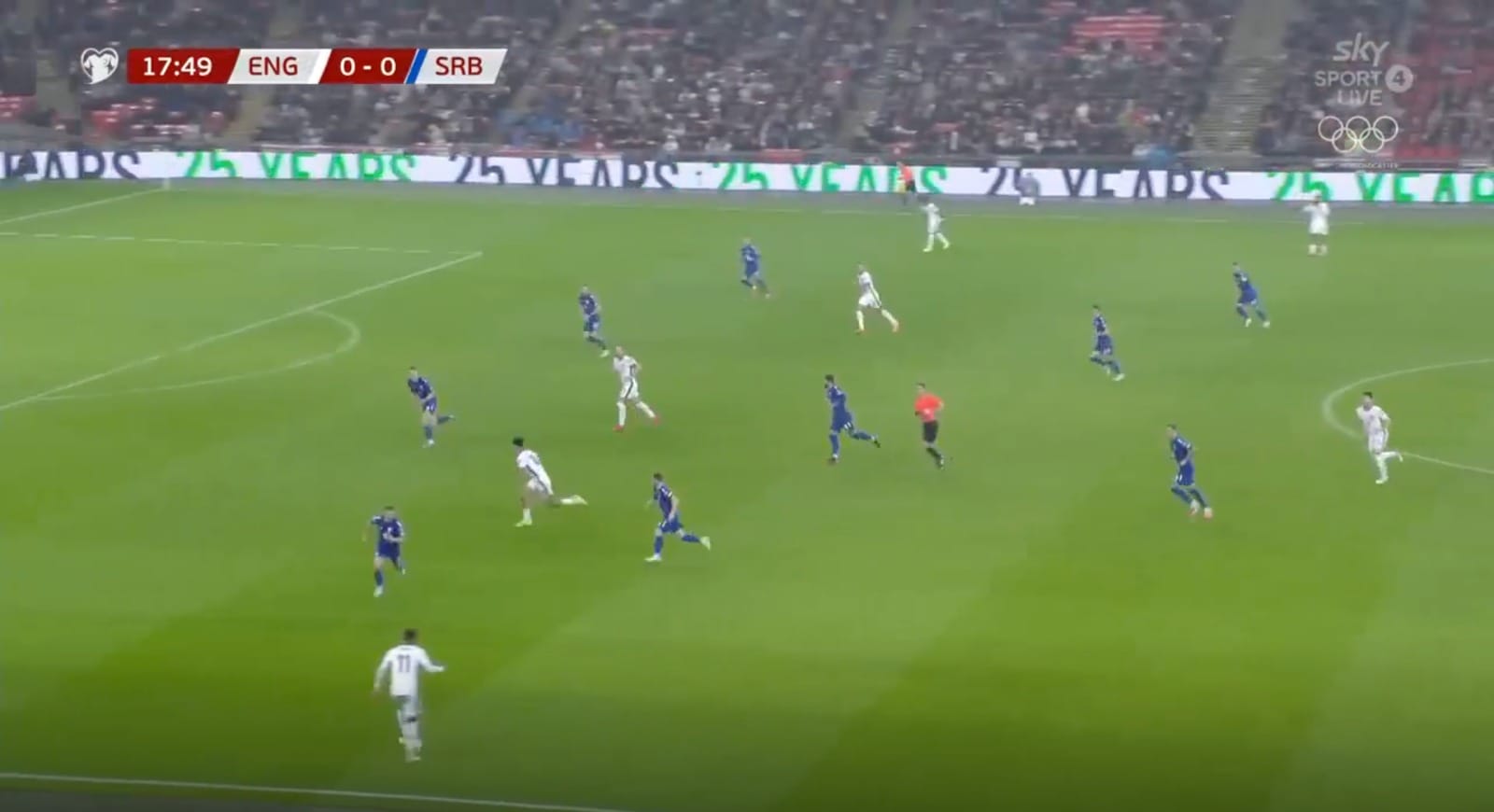
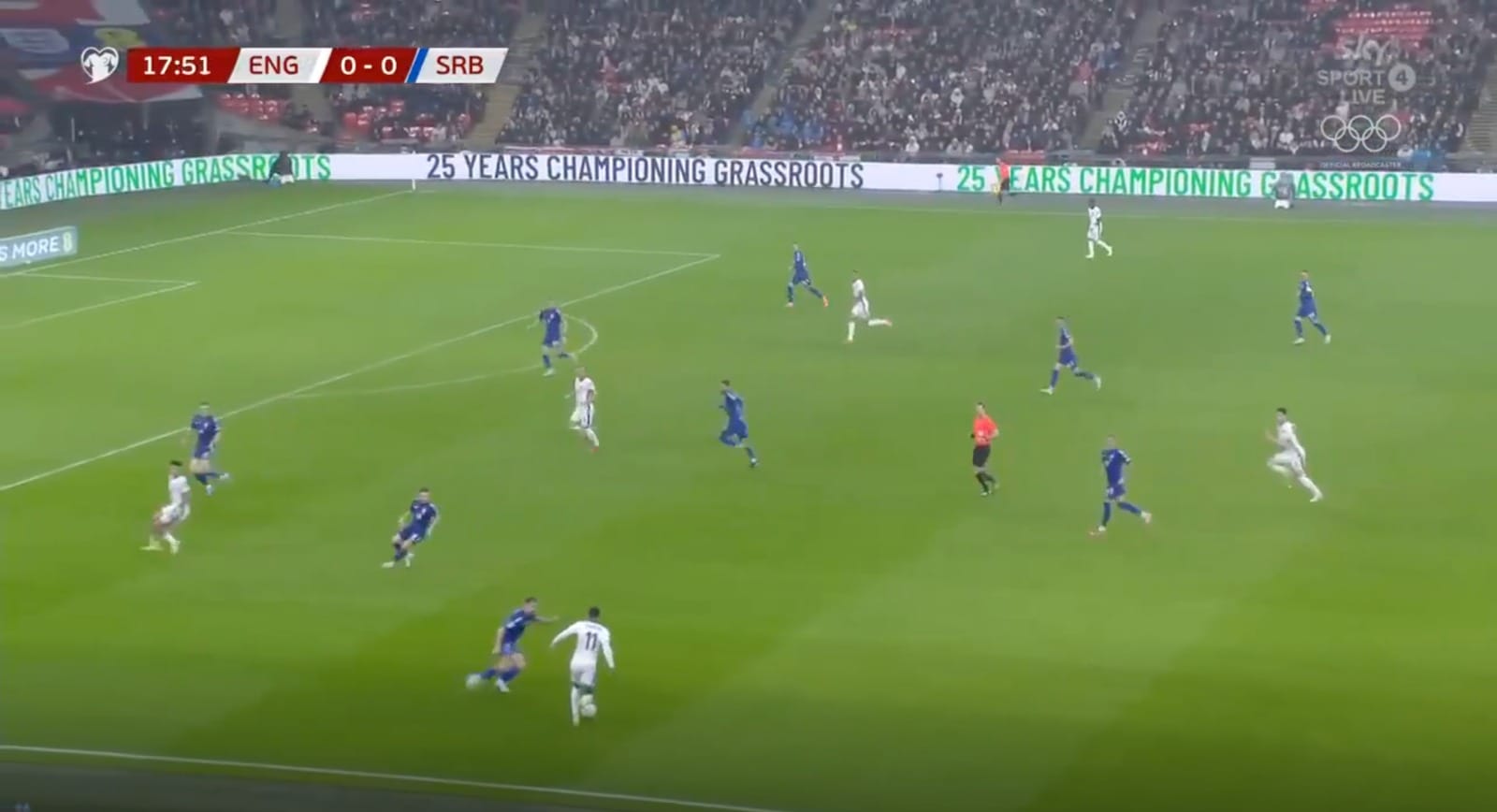
On the opposite side of the pitch, similar dynamics should occur between Reece James and Bukayo Saka. The two form a versatile winger-full-back partnership, capable of exchanging width, between-the-lines occupation, and depth-running responsibilities without difficulty.
More generally, the ability to combine width, runs in behind, and intermediate receptions appears to be one of the defining characteristics of Tuchel’s team. Furthermore, both Declan Rice from deeper positions and, potentially, Morgan Rogers from the attacking midfield role, are adept at recognising spaces that become vacant and joining these combinations.
If England are unable to break through immediately, they attempt to attract opponents in order to exploit the weak side, often through switches of play. Saka, Rashford, and Gordon, as well as potential alternatives such as Eberechi Eze and Noni Madueke, are all isolation wingers capable of cutting inside onto their stronger foot.
Speaking of switches of play, both Anderson and Rice are midfielders capable of executing long diagonal passes effectively. Yet the true excellence of England’s possession game is Harry Kane.
The Bayern Munich striker is the sun around which this team revolves. Everything revolves around him. His qualities as a playmaker are well known: Kane can drop onto the midfield line, receive possession from deeper teammates, and dictate where the attack should develop. For opponents, understanding who should follow a player who moves in this manner—and who often resembles a quarterback when facing forward—is extremely difficult. Even more so in international football, where the organisational level can never match that of club football.
Precisely because of Kane’s tendencies and Tuchel’s desire to place the keys of the team in his hands, the coach may make some unusual decisions in other areas. England’s second violin should theoretically be Jude Bellingham, but because Kane needs the freedom to drop deeper and influence the game, the Real Madrid midfielder’s place in the starting eleven is not guaranteed. Instead, it would not be surprising to see Morgan Rogers start matches.
Bellingham is not an easy player to manage from a tactical perspective. He is a midfielder who performs best as a shadow striker. However, his outstanding technical quality encourages him to involve himself in the action as much as possible rather than limiting himself to the final third. In essence, Bellingham would like to be a classic number ten, and it is no coincidence that he has repeatedly expressed his admiration for Zinedine Zidane.
The issue, however, is that the Birmingham-born midfielder is less effective than he believes at connecting play, due to questions of interpretation, decision-making criteria, and passing rhythm. Reducing the influence of a player who naturally seeks such a strong impact on the team would leave even more centrality to Harry Kane. Put simply, Rogers, unlike Bellingham, does not occupy the spaces that Kane prefers. Against Albania, with Bellingham on the pitch, the Bayern striker had to remain higher than usual precisely because the attacking midfielder often dropped deeper.
These are not easy decisions to make because Bellingham undoubtedly offers more quality than Rogers between the lines and sees different solutions. Leaving him on the bench means giving up actions such as the delicate chipped pass shown below, capable of activating combinations in advanced areas.
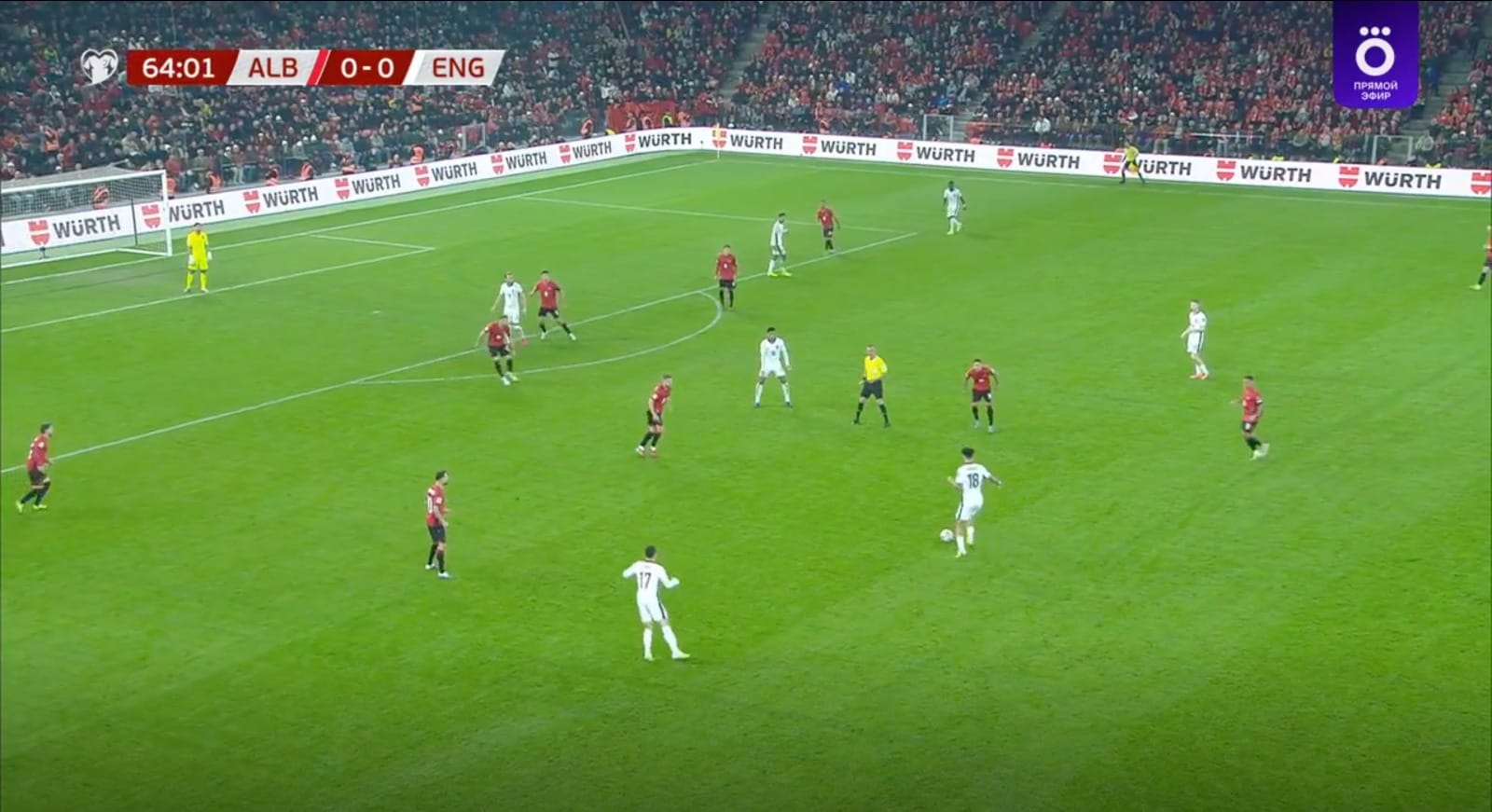
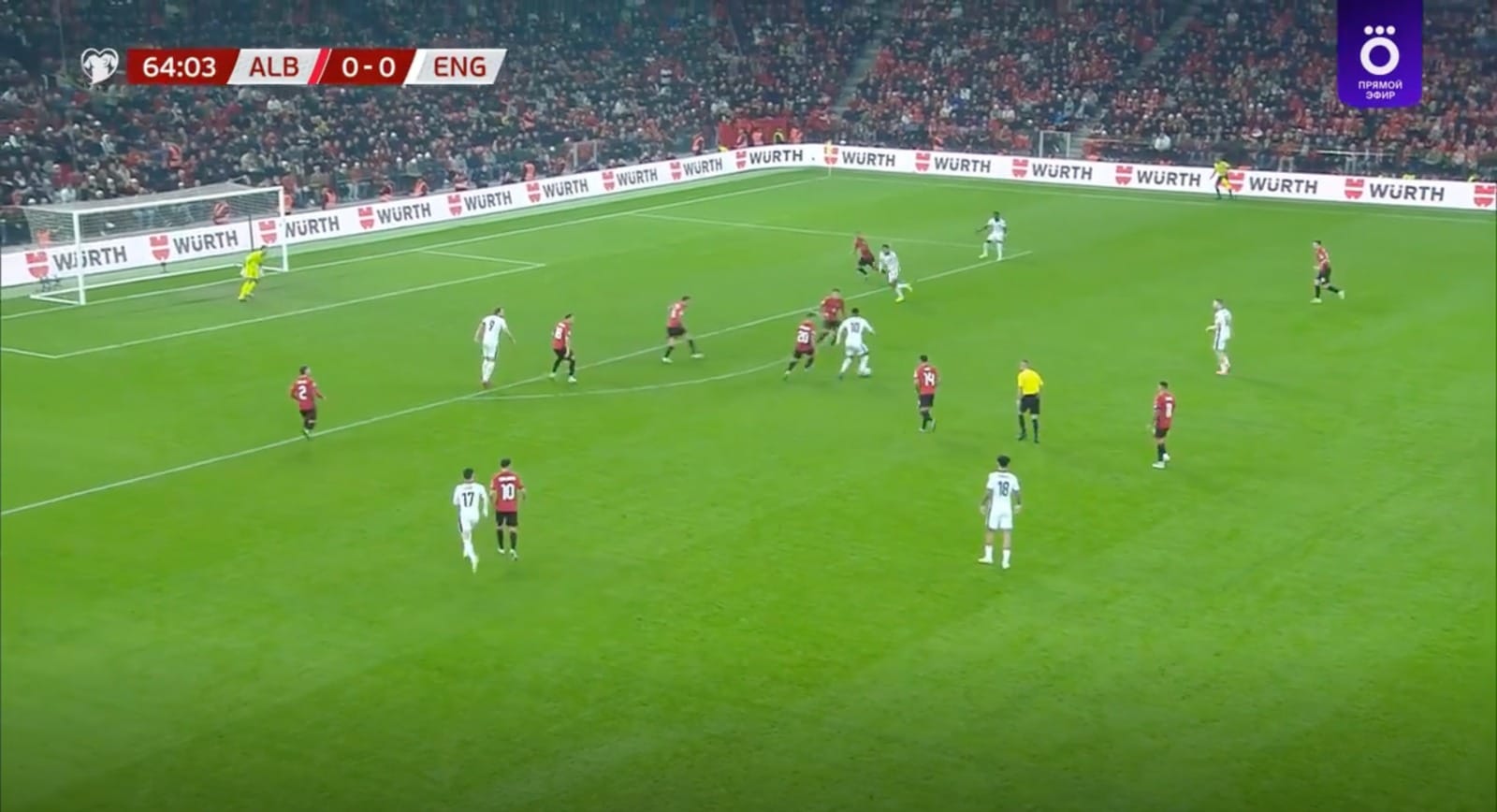
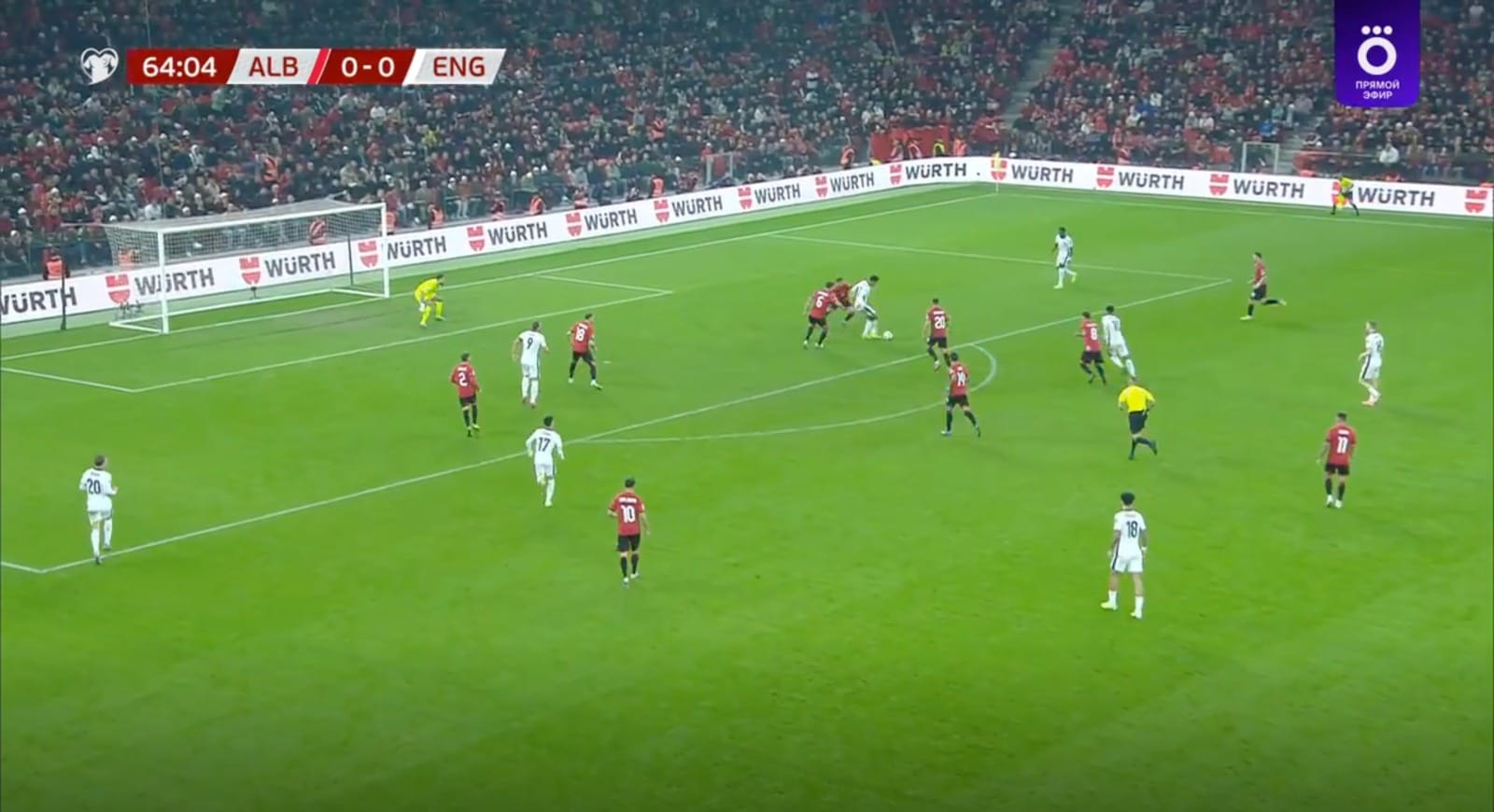
More generally, Tuchel has been coaching England for just over a year and has had only twelve matches available to him. At times, the team still appears somewhat disjointed or as if it remains in an experimental phase. In other words, the difficulties against low blocks that characterised Southgate’s tenure have not entirely disappeared. The decision to rely on explosive players such as Rogers and this group of wingers appears somewhat contradictory when compared to England’s underlying weaknesses. But at this point, lamenting the absence of creative players such as Gibbs-White and Cole Palmer is pointless.
In any case, this is only the eve of the tournament, and perhaps as the level of opposition increases, England will appear more polished.
England’s Pressing
Attack, however, is not the only unresolved issue for Tuchel. As mentioned earlier, the former Chelsea manager is attempting to build an aggressive team.
Without the ball, England generally shape up in a 4-4-2 structure designed to press high. The man-oriented references are not as extreme as those seen in some situations in contemporary football. In general, it is Harry Kane who leads the press, while one of the holding midfielders (usually Declan Rice) can step forward onto the attacking midfield line to support the pressure.
In its most ambitious versions, England ask their wingers to narrow their positioning during the press in order to block passing lanes towards the outside and force opponents to play centrally, where a ball recovery would be more dangerous.
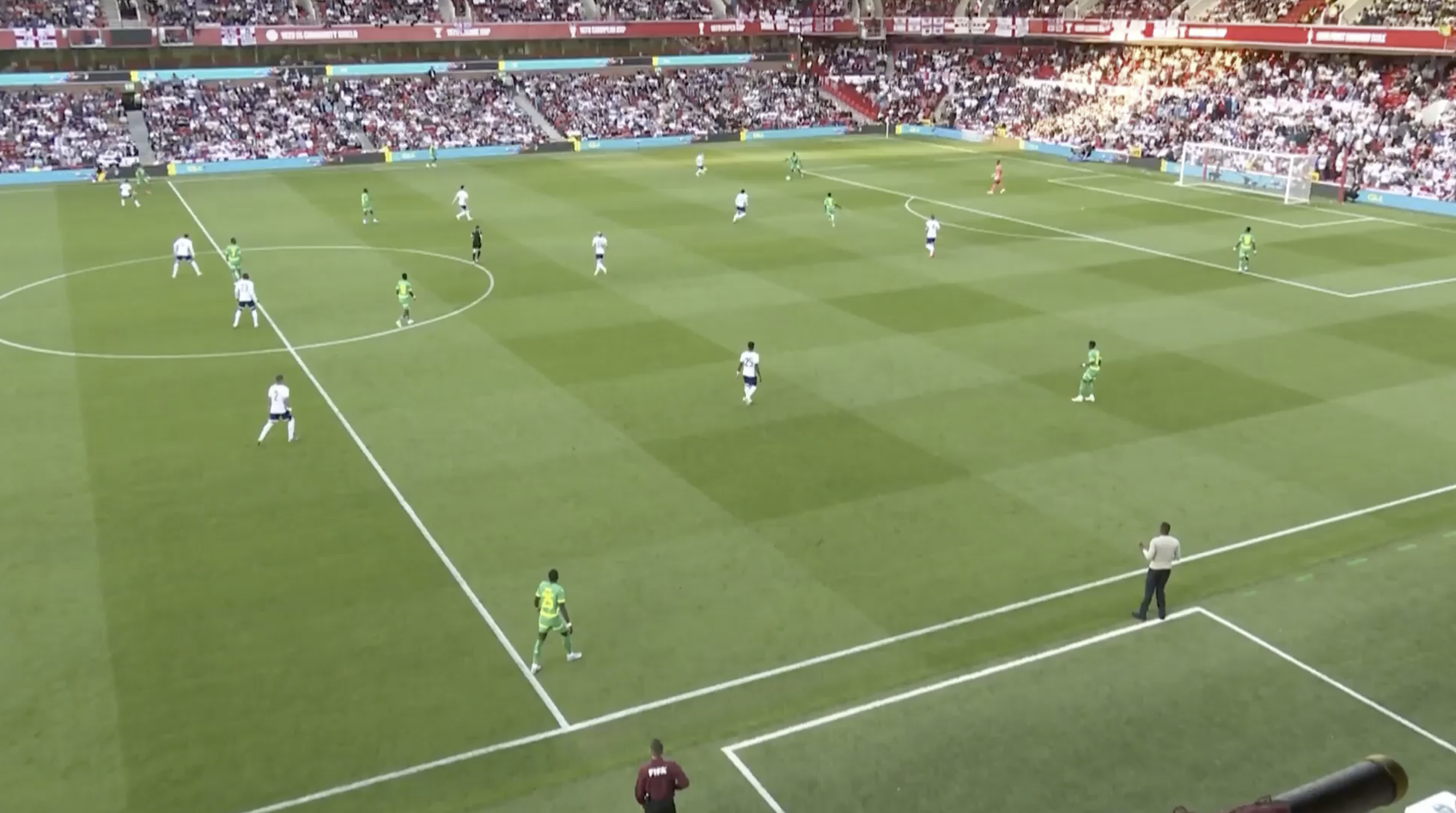
The matches against Senegal and Albania, however, showed that England have not always been efficient in these situations. When opponents managed to find a reception on the side of the holding midfielder, they were often able to progress up the pitch and reverse the momentum of the play.
Furthermore, Tuchel’s team has not yet had the opportunity to face top-level national sides—those that, at least in theory, possess the necessary tools to overcome an aggressive pressing structure. Would England maintain the same approach against opponents of equal quality?
And then there is the heat of the United States, which affected last year’s Club World Cup. How difficult will it be to sustain a precise and continuous pressing game under those conditions?
Especially considering that England also want to be aggressive when operating from a medium block.
World Cup Prospects
In short, there still appears to be a great deal of work ahead for Tuchel. His team is not yet fully efficient, and several issues remain unresolved, as demonstrated by the selection dilemmas in key positions.
A group featuring Croatia and Ghana is certainly not the easiest to navigate under these circumstances—not only because of the quality of the two teams, but also because of England’s difficult history against Croatia (2018 World Cup, Euro 2008 qualifiers) and because the Ghanaian community is one of the most deeply rooted in England. For several Black Stars players, this match will feel like a derby.
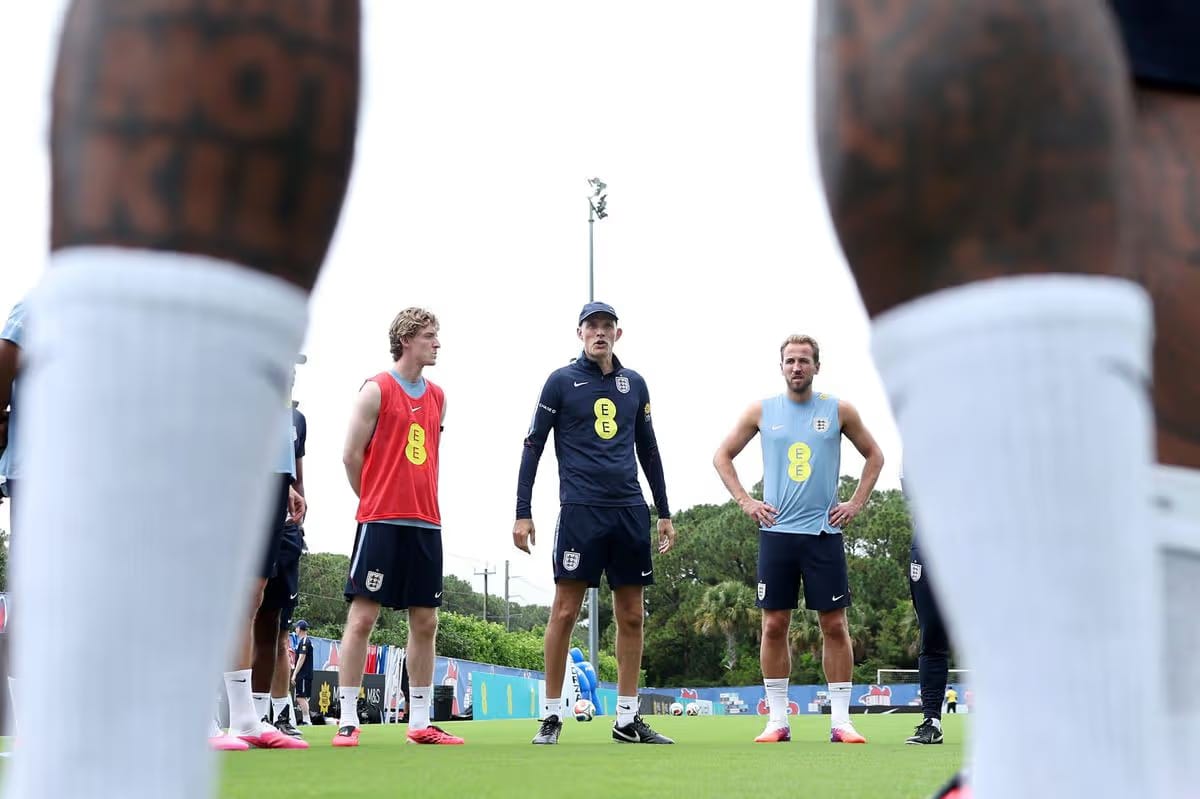
The quality of the squad and the possibility of qualifying even as one of the best third-placed teams, however, allow Tuchel to work with relative calm. Cases of national teams that immediately convince and dominate from the opening stages of a World Cup are rare.
Argentina in 2022, Spain in 2010, Italy in 2006, Brazil in 2002: even limiting ourselves to this century, history teaches us that World Cup winners often begin tournaments surrounded by doubts before gradually growing throughout the competition.
Will Tuchel’s England become part of this select group of national teams?
Or, once again, will the Three Lions collapse under the weight of expectations?

Emanuele Mongiardo is an Italian teacher who holds a Master’s degree in Contemporary History and is also a writer for L’Ultimo Uomo. He is particularly interested in technical and tactical analysis. Follow Emanuele on Twitter.