How to Beat the World Champions: Inside Tuchel's England

By Gaspar Vallecillo Castro
The England of Thomas Tuchel

“They were at the highest level in terms of conviction, team spirit and togetherness, and at the highest footballing level in every aspect of the game. We did everything that needed to be done together: playing out from the back, pressing high, and the attacking and defensive phases.”
Thomas Tuchel
[The Guardian]
I have the feeling that we have witnessed one of England's finest performances in the post-World Cup era, and I am genuinely excited. Every word I use, however, is rooted in the football displayed by Tuchel's England. Beyond a scoreline that might suggest a closely contested encounter, the red card and other factors will remain part of the story. But above all, what will endure is the football presented to our footballing community, on the perfect stage and against the current world champions: Spain, a national team widely respected for the way they play.
England demonstrated outstanding qualities in both aspects of the game: retaining possession and regaining the ball. Their performance embodied a collective principle that I would describe as travelling together: moving forward and recovering the ball as a connected structure.
A coaching friend once remarked over a Sunday coffee that travelling together was not only about the way a team moves in possession, but also about its intention to recover the ball. In football, the moments with the ball and without the ball are interconnected. This is perhaps the greatest challenge facing the modern game: training every stage of the Complete Game Cycle.
The Complete Game Cycle represents an interconnected continuity, limited only by the laws of the game. As Juan Manuel Lillo would say: “The greatest tactical textbook is the rulebook.” This was the starting point for the way Tuchel's England approached the game.
We must speak of a team shaped by its coach, primarily because a national team with its own identity represents a form of emergent stability.
In this match, England managed to overcome aspects of their game in which they had fallen short on several previous occasions. Their performance demonstrated greater maturity and a clear recognition of their own identity, allowing them to feel comfortable playing highly offensive football.
It is a style of play built around the need to dominate possession and travel together, maintaining an appropriate structure as the different phases and dynamics of the match evolve. And, for the most part, those moments belonged to England.
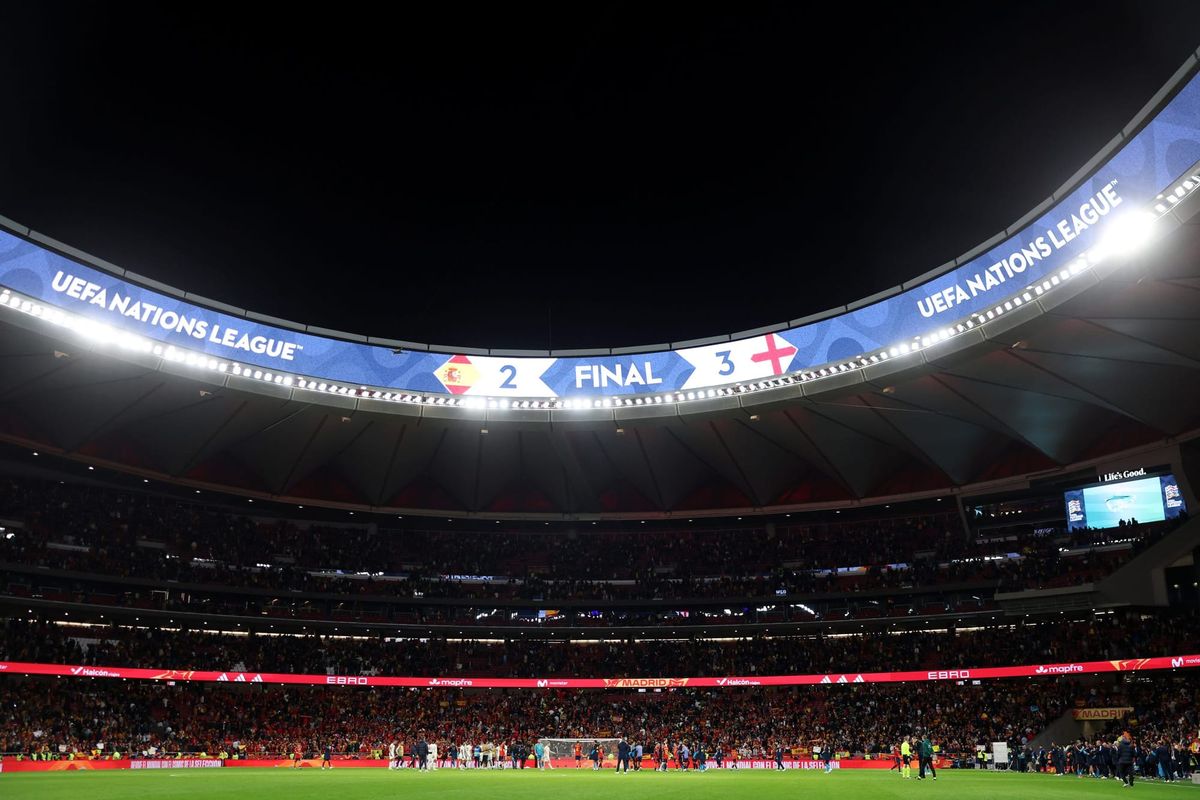
This match was no ordinary event. England's victory brought Spain's 43-match unbeaten run to an end. La Roja had begun this remarkable sequence in March 2024, establishing the longest unbeaten run by a senior national team in international competitions. This achievement included Spain's triumphs at the 2024 European Championship and the 2026 World Cup.
The significance of this result lies not only in the victory itself, but also in the football and competitive approach displayed by Tuchel's England.
Travelling Together I | Building from the Back
England operated as a highly proactive structure, creating advantageous situations through their ability to travel together. I want to emphasise this principle: it allows players within a team to maintain appropriate relational distances, creating numerical and positional advantages both when building play and when recovering possession.

“Playing good football, from my point of view, means making decisions according to the opponent's movements.”
Pep Guardiola
[90 Minutes with Pep, broadcast on Gol]
England consistently operated as a collective unit from the moment they began building from Trafford, with the goalkeeper attracting and fixing opponents in position. They waited for the right moment, using the time created by this fixation to generate the space needed to play through their centre-backs.
On many occasions, England adopted the well-known La Volpe build-up structure, with a defensive midfielder dropping between the centre-backs. This encouraged the centre-backs to split wide, while the full-backs could position themselves higher up the pitch to create genuine depth and positional advantages.
Declan Rice operating in the space between the centre-backs, Elliot Anderson positioned behind the opposition's pressing line, and Jude Bellingham acting as a free-roaming player, with the full-backs occupying positions around midfield height, created a highly complex spatial and temporal problem for Spain to defend.
If a Spanish player jumped out to press Rice, the nearest midfielder was freed. If one of Spain's forwards moved towards the centre-backs, England could find a clean route forward through the centre.
When Spain attempted to establish individual match-ups, Bellingham took responsibility for managing his own resources in order to support the team's combination play.
Travelling Together II | Playing Vertically from Midfield

“I feel the responsibility to take the team to another level, and to another level of intensity.”
Jude Bellingham
[Mixed Zone, following the victory against Panama, 2026 World Cup]
Understanding the game requires the constant ability to respond to different pressing structures.
Spain generally adopt a high press. Once that initial pressure was bypassed, however, La Roja maintained a structured mid-block.
This was where Bellingham began to operate more freely, looking to connect passes, escape pressure, provide constant support, switch the direction of play and move the ball forward.
What makes this English number ten so special is his ability to vary his resources according to the demands of each game situation. At times, he operates through positioning and spatial occupation; at others, through movement, runs and ball carries.
Football is about the dynamic versatility of variability: being able to contribute in different ways and at different rhythms while maintaining quality.
And the Real Madrid player embraces that responsibility.
Travelling Together III | High Pressing and Ball Recovery

“Given the circumstances, the pressure, the quality of Spain, where we were playing and who we were playing against.”
Thomas Tuchel
[Post-match press conference following the game against Spain]
Pressing triggers, the timing of pressure, pressing trajectories, individual match-ups, 1+1 situations, tracking runs and collective pressing were constant features of England's performance.
All of this demonstrated a continuous interconnection, from the moment of initiating the high press to the organisation that followed ball recovery.
But how exactly did all these elements work? Let's break it down.
England's high press created specific spatial and temporal situations that favoured them, particularly through the way they influenced Unai Simón and, above all, Spain's two central midfielders during their build-up.
Harry Kane rarely pressed the Athletic Club goalkeeper directly, which created an advantage within England's pressing structure.
Rice (who, incidentally, delivered an outstanding, masterclass-level performance) was responsible for Zubimendi, while Anderson matched up against Fabián, making it extremely difficult for Spain to build cleanly from the back.
When this pressing structure was bypassed, England compensated for the potential loss of space through tracking runs from their wide players or forward jumps from the last line of the team, allowing them to recover possession.
Tuchel's 3-2-5 structure
The author recommends reading this Thread on X by writer and football thinker Martí Perarnau: A Thread on the Cambridge Pyramid.
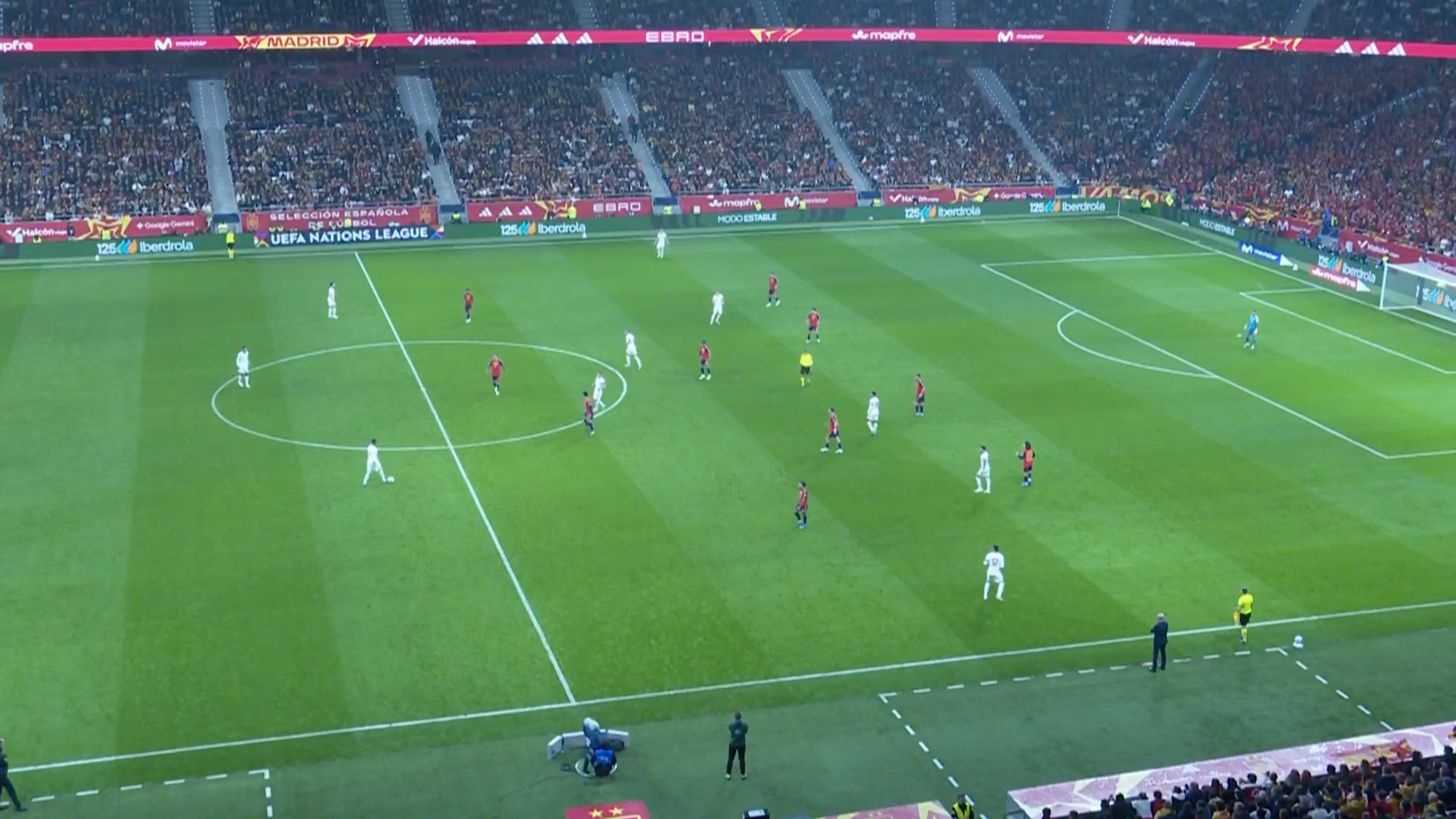
For significant periods of the match, England evolved into a 3-2-5 structure. This allowed them to build cleanly, operating with a 3+2 structure in midfield areas, supported by centre-backs positioned higher up the pitch.
The wide players occupied very wide positions, creating the possibility of having three players positioned beyond the opposition's pressing line. This made the structure particularly difficult to defend against.
This illustrates an important concept: systems are behaviours that emerge from constant fluctuations and interactions. Their stability is constrained by the synergistic behaviour of all players, both in relation to the ball and within their respective phase spaces.
The Beginning of a New Hierarchy in the Game?
A national team featuring the current Ballon d'Or winner, a player with an exceptional ability to interact with his environment, and a midfielder who consistently performs at the highest competitive level.
Yes, these descriptions are accurate, or at least almost always are.
First, we are referring to Harry Kane. His contribution to the English national team goes far beyond goals, important appearances or even assists, which have long been part of his game.
Kane deserves the Ballon d'Or because he is a completely different kind of striker. He is a complete player who understands the game not only through his primary position, but also through the different roles he can assume. This creates situations in which his teammates can benefit from his actions, while he himself benefits from their movements and decisions.
When looking for the right words to describe Jude Bellingham, we must start with his interpretation of his associative abilities, which emerge through his technical quality and his understanding of the concept of prioritising touches.
Bellingham is a different kind of midfielder. Of course, he possesses outstanding physical attributes and an exceptional ability to cover ground. But his repertoire extends much further: fixed positional references, the ability to find space behind the opposition's pressing line, well-oriented first touches and receiving actions that create advantages for his teammates.
That is what we ultimately call talent: when different qualities emerge and interact in favour of the collective.
That is what a midfielder is.
And what can we say about a midfielder like Declan Rice, who constantly makes himself available through his positioning, involvement in the game and competitive efforts for his national team?
From this side of the Atlantic, we hope England continue to compete with this approach to the game. Because, as Spalletti once said: “The only thing that saves the game is the team.”

Gaspar Vallecillo Castro works with the Honduran Football Federation as a Technical Development Advisor in FIFA’s TDS program. A professional writer and CONMEBOL PRO licensed coach, he specialises in coach education and in the on-field application of positional play. Follow Gaspar on Twitter and LinkedIn.