Roberto De Zerbi at Tottenham Hotspur: To Dare Is To Do

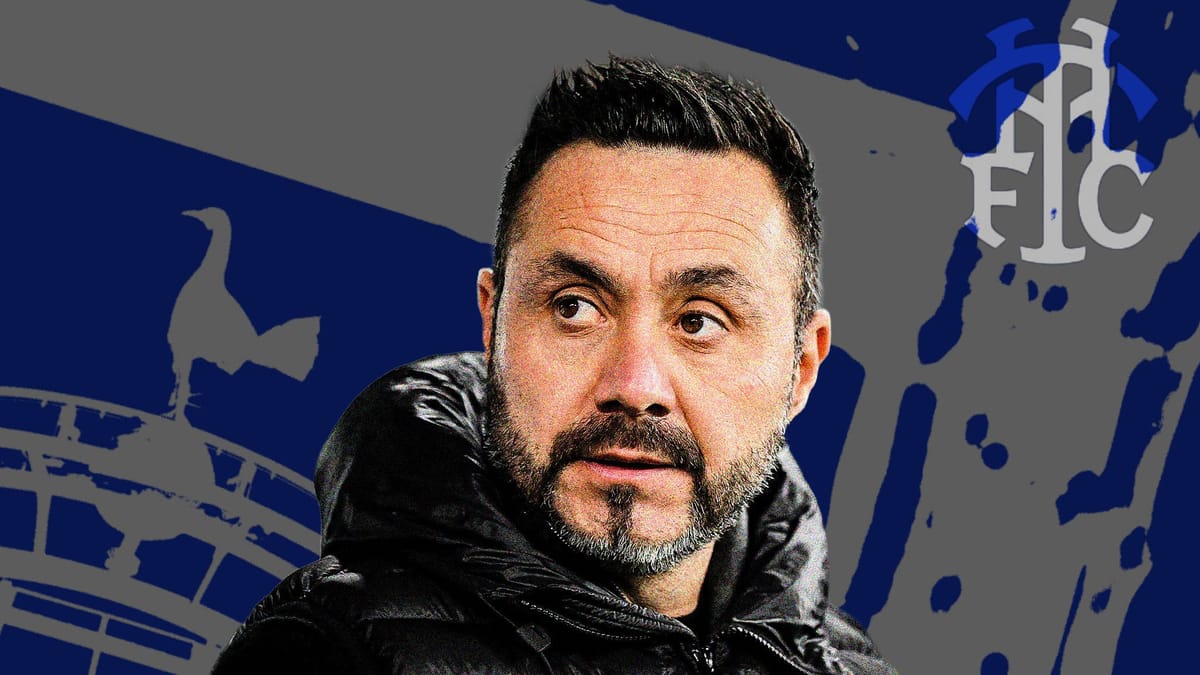
The potential appointment of Roberto De Zerbi as head coach of Tottenham Hotspur opens up a layered tactical discussion that extends beyond stylistic identity and into a more delicate dimension: the alignment between competitive urgency and methodological complexity.
De Zerbi’s football is not merely an aesthetic proposition; it is a deeply codified positional framework built upon precise spatial occupation, calculated risk in the first phase of build-up, and the intentional manipulation of opposition structures. His teams do not avoid pressure—they invite it, drawing opponents forward to destabilize their shape before exploiting the weak side or interior channels with vertical precision. This approach demands not only technical quality, but also high-level cognitive processing: players must continuously interpret cues, adjust positioning, and execute under pressure within limited time and space.
Such sophistication, however, cannot exist without time. It is intrinsically dependent on repetition, shared references, and the gradual internalization of principles. The immediate challenge, therefore, lies in context: implementing a highly demanding model within a team that may not yet possess the automatisms required to sustain it—particularly in a phase of the season defined by limited training time and high competitive density.
Within this scenario, an additional and fundamental priority emerges: the need for competitive stability and Premier League continuity. In a club that has experienced structural fragility and inconsistency in recent seasons, De Zerbi’s initial task will not be solely to impose a clear game identity, but to rebuild a solid mental foundation. Across his previous experiences—most notably in Marseille—his ability to elevate collective performance has been closely tied not only to tactical clarity, but also to strong individual accountability. His methodology operates as much on belief and resilience as it does on structure, shaping how teams manage critical moments and sustain competitiveness over time.
In the short term, a degree of operational flexibility becomes almost inevitable. Rather than a full implementation of his positional play, we can expect a calibrated version—one where structural clarity takes precedence over systemic depth. This may translate into a more cautious build-up, reduced exposure in central zones during early phases, and a greater reliance on transitional moments as a source of attacking output. Defensive organization, too, may adopt a more pragmatic orientation, prioritizing compactness and control over aggressive positional pressing. In this phase, results carry heightened importance, becoming a key component in rebuilding confidence and collective stability.
This transitional stage should not be interpreted as a deviation from De Zerbi’s philosophy, but rather as a strategic adaptation to contextual constraints. The core ideas remain intact, albeit expressed in a more accessible and less demanding form—allowing players to progressively adjust without sacrificing immediate competitiveness.
It is over the medium to long term—particularly through pre-season and sustained training cycles—that the true identity of a De Zerbi team can fully emerge. With time, the positional structure becomes more refined: the first phase evolves into a platform for superiority creation, the occupation of half-spaces becomes more deliberate, and the team develops the capacity to control rhythm through circulation and spatial manipulation. The objective is not merely progression, but control—of the opponent, of space, and ultimately, of the game itself.
In this light, any evaluation of Tottenham’s performances in the early stages of this potential transition should be framed within a broader temporal perspective. Immediate results will inevitably reflect a balance between necessity and identity, between urgency and construction, while the deeper and more distinctive characteristics of De Zerbi’s model will require continuity, patience, and an environment that supports methodological rigor.
Ultimately, the success of such an appointment will depend not only on tactical compatibility, but on the alignment between club expectations, player profiles, and the time granted to transform complexity into collective understanding—without losing sight of the primary short-term objective: restoring stability, competitiveness, and a sense of security to a team that, above all, needs to rediscover itself.