How Kompany and Luis Enrique Reinterpreted Positional Play

By Rodrigo Seixas
Football has always gone through changes — that is part of its nature and what makes it even more interesting. For this reason, it is curious to observe how positional play, so popular in recent years, has itself undergone transformations.
Before anything else, positional play is a model in which the team organises players by occupying specific zones of the pitch, maintaining structure, distances, and clearly defined passing lanes. The idea is to generate superiority through spatial organisation. The concept has existed for decades, with influences from schools such as the Dutch one and coaches like Rinus Michels, but it became widely popular again between the 2000s and 2010s through Pep Guardiola.
Now emerge the figures of Vincent Kompany and Luis Enrique, who learned the game and are introducing new ideas into it. Kompany and Guardiola maintain a relationship almost akin to mentor and apprentice. Former captain of Manchester City, Kompany considers Guardiola the best coach he has ever had, citing him as his main tactical inspiration. Meanwhile, Luis Enrique and Guardiola share a long-standing relationship, marked by close friendship and a shared history at FC Barcelona, where they were teammates in the 1990s.
Luis Enrique and Kompany follow the positional play model, and both possess ideas similar to Guardiola’s. The principles of positional play remain present in the football of Paris Saint-Germain and Bayern Munich, the teams they manage. These include the rational occupation of space, the search for superiority, the constant creation of passing lanes and support angles (neither too close, so as not to overcrowd spaces, nor too far, so as not to break connections), as well as width, compactness, and more.
However, over time, some concepts of positional play became too familiar to opponents. Defeats such as Luis Enrique’s with the Spanish national team against Morocco at the 2022 FIFA World Cup raised warning signs for change. In Kompany’s case, he already emerged as a coach in 2020 with different experiences and new ideas.
Yet, sometimes innovation comes from the past, and there is something heavily used in PSG’s game that originates there. Luis Enrique, as a deep connoisseur of positional play, began to make extensive use of a concept whose origins trace back to Michels, creator of Total Football with Ajax and the Dutch national team of 1974: the “Dutch Carousel.” In this context, the current PSG can be seen as a contemporary reinterpretation — a true “French Carousel.”
As described in Inverting the Pyramid: “Michels’ Ajax was the first team to encourage positional interchanges in attack, and what made this possible was pressure. Suddenly, it no longer mattered if there were forty metres of space behind the deepest defender because, if an opponent received the ball, he would be surrounded so quickly that he would not be able to make an accurate pass.”
This idea appears clearly in Luis Enrique’s PSG. The logic behind using the carousel is to alter defenders’ references, or force man-oriented tracking, without breaking the team’s structure. It consists of rotating pieces in search of opening spaces, while maintaining the logic of support, width, and depth.
Furthermore, PSG, through large numbers of passes and intense pressure on the ball, suffocates opponents and dominates territory. Against Liverpool FC, for example, they sustained a PPDA of 5.07 and averaged 14 passes per possession, totalling 776 passes in the match. The model consists of circulating the ball to attract the opponent, maintaining possession, and disorganising low blocks, seeking penetrations down the flanks through these carousel movements, which become even more evident against back fives.
Notice in the goal how PSG manages to win individual duels. First Nuno attracts Olise, Fabián stays wide, escaping Laimer’s sphere of action, while Kvaratskhelia moves closer to receive and combine with Fabián. In a movement that attacks the very space created by dropping deeper and attracting Upamecano. On the opposite side, Dembélé remains wide, waiting for the right moment to enter the box and score.
And it does not stop there. New nuances within positional play continue to emerge: more individual pressing without cover, more compact teams organised to recover possession immediately and initiate another attacking sequence, even more mobile false nines dropping into the build-up phase, emptier midfields at the base of play, less symmetry, more relational traits, more long passes in the build-up, and fewer passes overall.
Modern false nines roam far more across the pitch, participate in the first phase of build-up, and press with intensity. With more vertical teams, the number of passes also decreases. Whereas teams such as Barcelona 2011 displayed great symmetry and extremely well-defined distances, today’s sides are more compact, less symmetrical, with players closer together and constantly moving.
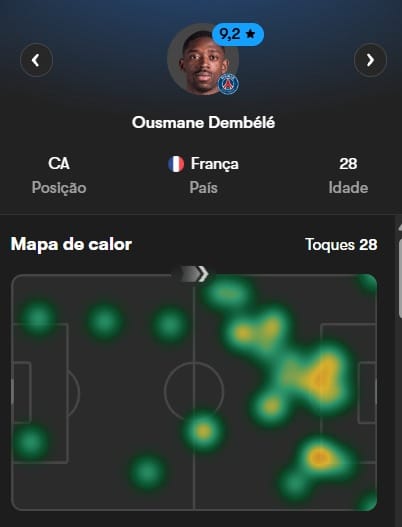
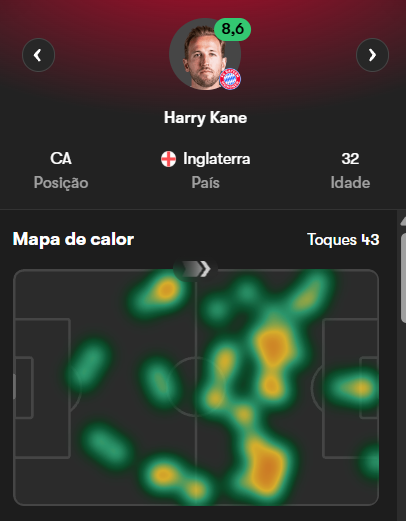
Both Harry Kane and Dembélé frequently drop back even before the halfway line. © FotMob
Kompany follows much of the same line present in PSG’s game. He places great emphasis on maintaining a compact team in order to create multiple passing options and keep players close enough to recover the ball after losing it. This generates a succession of attacking attempts that can be described as offensive waves. Within them, the team seeks to place players in favourable 1v1 situations, with constant movement, Harry Kane frequently dropping to orchestrate play, and heavy use of the half-spaces. It is also a team that relies on long passes when pressed and attacks the space behind the opposition defence extremely well, whether in transition or not.
Notice how Bayern stay extremely close together and very advanced in the opponent’s half. The idea is to have several players supporting the attack while also maintaining the possibility of recovering the ball immediately. Extremely compact.
Guardiola himself has also evolved: the use of attackers based more on power than technical finesse, goalkeepers with less protagonism in build-up, midfielders freer from the model, “false” players in other positions such as John Stones and Nico O’Reilly, as well as more long passes in build-up and fewer passes overall, with greater verticality.
This scenario is also influenced by the rise of individual marking and higher defensive lines, which emerged as antidotes to traditional positional play. This further reinforces the use of the carousel — constant positional interchanges — highly present at PSG, even breaking old rules such as not switching sides before the final third. Even so, everything must function within the system. It is necessary to balance control and chaos and, in modern football, being slightly closer to chaos may be advantageous, even if it reduces absolute control over the game.
Luis Enrique, therefore, needed to adapt positional play to the evolution of football itself. It is a constant cat-and-mouse game: when one idea works, an antidote appears and, from it, new solutions emerge.
At the same time, other ideas arise, such as Fernando Diniz’s “full parallel” model — a more apositional game that concentrates players on the same side of the ball, where relationships between players matter more than positioning itself.
The clash between PSG and Bayern Munich in the Champions League semi-final made these changes even more evident. The match in Paris was extremely open, featuring a huge number of quick attacks, intense pressing, individual matchups, movements to disrupt man-marking, rapid ball circulation, carries with the ball at the feet, and a great emphasis on dribbling. Two teams unafraid of risking the loss of control in order to play vertically and attack the goal. Something not so visible in older positional play teams, which prioritised control more heavily. Notice how different this is from the Spanish national team of 2010, which often used possession to maintain control and keep opponents far from goal.
In the semi-final match in Munich, PSG managed to control Bayern better, and the game became less open. Luis Enrique altered some dynamics within his team, even instructing the goalkeeper to deliberately kick the ball long in order to keep Bayern further away from goal and enable pressure on the full-back’s build-up. The idea of intentionally giving possession to the opponent is also uncommon in positional play teams. These details helped the Parisian side overcome the German team and reach the final.
Notice how Safonov deliberately kicks the ball out in these situations.
Kompany and Luis Enrique confirmed these new ideas within positional play during this Champions League semi-final, incorporating elements of relational play and gegenpressing. Alongside other coaches, including Guardiola himself, they demonstrate that football remains in constant evolution.